Where Salvadoran Children Hope to Arrive

With 323 interviews with Salvadoran children deported from Mexico transcribed, translated and coded, I’ll be making several posts about origin, destination and cause in the coming days. Because the Foreign Ministry here is interested in where Salvadoran communities are largest in the US, I am delivering this information first.

301 of 323 (93.2%) wanted to reunite with a family member or close friend who s/he considered family in the United States. The largest number (12%) wanted to go to New York. Of the 39 children who hope to arrive there, 10 are female and 29 are male. The second largest number (11.8%) wanted to end up in Los Angeles, California or Houston, Texas. Of the 38 kids hoping to reach LA, 14 are female and 24 are male. Of the 38 hoping to reach Houston, 17 are female and 21 are male. In fourth, 31 (9.6%) wanted to go to Virginia, 13 of whom are female and 18 of whom are male. In fifth, eight females and 11 males wanted to be in Maryland, for a total of 19 (5.9%). Twelve (3.7%) were headed for Dallas, Texas: four females and eight males. Another eleven (3.4%) hoped to arrive to Atlanta, Georgia: two females and nine males. Boston, Massachusetts followed as the eighth most common destination, with 10 children (3.1%) headed there: two females and eight males. Rounding out the top ten are North Carolina and Tennessee, where nine (2.8%) each wanted to arrive: four females and five males to NC and two females and seven males to TN. Other locations with five or more include: Washington, DC, New Jersey, and San Francisco, CA.

As you can see, the list is a mixture of states and cities. Children — and their family members — were often unable to name a city within a state, with cities in California and Texas being the exceptions. Specifically, if participants were headed for “Washington,” they struggled to state whether they meant the state or city. Fifteen of 323 (4.6%) were unsure where in the United States they would live. Nine (2.8%) said they were going to live with both parents, even though their separated or divorced parents lived in states hundreds of miles from each other (for example, California and New York or Florida and Texas). Six (1.9%) did not know where their relative lived.

Ten of 323 (3.1%) wanted to arrive to the United States but do not have family or friends there. They also could not name a city or state where they hoped to reside.

Three of 323 (0.9%) wanted to stay in Mexico. All three were females and were traveling with other family members who had already resided there for two years or more. One family fled El Salvador when they could no longer pay the neighborhood gang’s renta, and the other left to escape their husband/father’s abuse.

Finally, nine of 323 (2.8%) did not respond to this question. In reality, their bus was leaving, and we ran out of time. Everyone to whom I’ve posed the question has responded.

Open Borders: Economically and Morally Right

George Mason University economics professor, Bryan Caplan, has long been a proponent of open borders. In his recent econlog entry (http://econlog.econlib.org/archives/2014/05/meant_for_each.html), he repeats several points he’s made before to attempt persuading those who currently support border regulation. Not surprisingly, his arguments have a strong economic focus: from increasing global GDP and worker productivity, to regulating which jobs migrants can take, to protecting native workers from job loss, to ensuring migrant labor supplies native demand.

He does, however, start with a critical point: closed borders are in direct opposition to a free and open society.

Caplan writes that the extent to which we get to live in a free and open society is largely determined by who our parents are and where they live. Indeed, many in the global South have no hope of getting a visa to legally travel to the global North because of requirements to prove a certain level of economic stability.

At the migrant centers here, I’ve met a number of Salvadorans who have resident or citizen family members in the United States who could sponsor their visa applications. Yet, I meet all of them because they elected to travel without documents. Some attempted to obtain a visa and were rejected, with no explanation and at the loss of one or two month’s salary. Instead of traveling safely and buying a plane ticket, they risk their lives and wellbeing and often pay thousands of dollars more to a coyote (human smuggler) who is likely tied into an organized criminal network. So besides being economically bad for business and conversely good for crime, close borders cheapen human life.

This is morally unacceptable. The decision to deny a visa and to deny a safe option for travel is a death warrant for hundreds of migrants each year. For others, it will mean rape, loss of limb or assault. And for nearly all, it will mean robbery and bearing witness to someone else’s trauma. At the same time, it ensures the division of families, which disproportionately affects children. They will spend years feeling something or someone missing and will likely embark on the dangerous journey themselves when no legal options exist for a family visit.

One of the youth I’ve highlighted in the Migrant Return Center Report said that he wanted to migrate to the U.S. to attempt becoming an actor. After he said those words to me, he asked: why is it that you can come here [to El Salvador], but I cannot go there [the United States]? The only answer I could give him: the world is unjust.

I knew my privilege before I got here, and yet, that conversation still sticks with me. Many migrants I meet here will attempt that dangerous journey again, and some will be harmed greatly or die doing so. Yet, Western politicians fail to see this human security element at the same level of importance as the border security element.

The Injustice of a Child Migrant’s Death

In March, a 12-year-old committed suicide in a Mexican shelter for migrant children. One of the first reports can be found at this link:  http://www.elpasotimes.com/latestnews/ci_25367695/girls-suicide-juarez-shelter-prompts-human-rights-investigation . Her guide, or smuggler depending on how you view the profession, told her to lie about her age, name and country of origin. So, she said she was eight instead of 12, shortened her name, and said she was from Southern Mexico instead of her native Ecuador.

Many migrants use such strategies, especially those who are not from Mexico. As long as you are Mexican, you will not be deported, but Mexico deports anyone else back to their country of origin. For example, in El Salvador, Mexico deports anywhere from 60 to 190 Salvadorans a day. Many of them want to attempt migrating again, which means re-tracing dangerous ground they already covered.

Nonetheless, some started to speculate that Noemi was raped on her journey. You can see one story here: http://newspapertree.com/articles/2014/04/07/a-little-girl-named-nohemi-martyr-of-migration . How common rape is on the journey is underreported officially and likely over reported by advocates. Advocates claim that eight of ten women who make the journey are sexually violated, and police claim hardly any are. The advocates are likely closer to the truth.

Regardless, Noemi was inconsolable when she reached the migrant shelter. She had attempted the journey seven months before and failed to reach her parents. Whether she was raped or not, she likely endured great hardship as she traversed miles on foot, in bus and hiding in compact spaces of vehicles. She probably witnessed other atrocities of migrant abuse, cartel or gang violence, and official corruption. She had been through a lot. She went into the shelter’s bathroom and took her own life.

Locating her parents to inform them was initially difficult because of the lies meant to help her reach them. I’ve met three mothers here in the same situation. They never got to say their last words to their daughters and son, because they used a different, Mexican name while migrating and now cannot be found. We presume they too died on their journey to the US.

The New York Times went to where Noemi lived with her grandparents in Ecuador’s highlands (http://www.nytimes.com/2014/04/20/nyregion/a-12-year-olds-trek-of-despair-ends-in-a-noose-at-the-border.html). There, 60 percent of children live with grandparents, aunts or uncles because their parents are in the US. They’re trying to escape poverty and make a better life for themselves. They’re not afraid to work to do it, and they have no choice but to take a large amount of risk.

While most unaccompanied child migrants are from similar communities in El Salvador, Guatemala, Honduras and Mexico, more Ecuadoran children are arriving than ever before. A few years ago, only handfuls came, but now hundreds are arriving.

Every day, I work with children like Noemi in El Salvador and parents like Noemi’s in New York and other US cities. These children and parents want to be together, and they want the best possible future for each other. Our immigration system does not allow either to happen easily, and that’s more than a shame.

It is a great injustice.

Noemi did not have to die, but our system created a perfect storm for her death to be possible.

LA INJUSTICIA DE UN NIÑO MIGRANTE

En marzo, una niña de 12 años de edad cometió suicidio en un refugio Mexicano para niños migrantes. Uno de los primeros informes se puede encontrar en este enlace: http://www.elpasotimes.com/latestnews/ci_25367695/girls-suicide-juarez-shelter-prompts-human-rights-investigation . Su guía, o contrabandista dependiendo de la forma en que se vea la profesión, le dijo que mintiera acerca de su edad, nombre y país de origen. Así que, ella dijo que tenía ocho años en lugar de 12, acortó su nombre, y dijo que era desde el sur de México en lugar de su natal Ecuador.

Muchos migrantes utilizan este tipo de estrategias, especialmente aquellos que no son de México. Siempre y cuando tu seas mexicano, no serás deportado, pero México deporta a cualquier otra persona  a su país de origen. Por ejemplo, para el caso de El Salvador, México deporta, desde cualquier lugar, de 60 a 190 salvadoreños al día. Muchos de ellos quieren intentar migrar de nuevo, lo que significa volver a trazar un peligroso terreno que ya había sido cubierto.

No obstante, algunos empezaron a especular que Noemí fue violada en su viaje. Usted puede ver una historia aquí: http://newspapertree.com/articles/2014/04/07/a-little-girl-named-nohemi-martyr-of-migration . Es común que las violaciones en el viaje no se reporten oficialmente y probablemente son más de las que informan los defensores.  Estos últimos afirman que ocho de cada diez mujeres que hacen el viaje son violadas sexualmente, mientras la policía afirma que estas apenas algunas lo son. Probablemente son los defensores los que se encuentren más cerca de la verdad.

A pesar de todo, Noemi estaba inconsolable cuando llegó al refugio de migrantes. Ella había intentado el viaje siete meses antes y no pudo llegar hasta sus padres. Ya sea que fue violada o no, ella posiblemente sufrió grandes penurias mientras atravesaba millas a pie, en autobús y se  escondía  en pequeños espacios  de vehículos. Probablemente ella fue testigo de otros atroces abusos de migrantes, carteles,  violencia de pandillas y de la corrupción oficial. Había pasado por muchas cosas. Entró en el baño de la vivienda y se quitó la vida.

Localizar a sus padres para informarles fue inicialmente difícil debido a las mentiras destinadas a ayudarle a llegar ellos. Aquí he conocido a tres madres en la misma situación. Nunca llegaron a decir sus últimas palabras a sus hijas e hijos, debido a que estos utilizaban un nombre Mexicano diferente mientras migraban, y ahora no se pueden encontrar.  Suponemos que ellos también murieron en su viaje a los EE.UU.

The New York Times fue al lugar donde Noemí vivió con sus abuelos en las tierras altas de Ecuador (http://www.nytimes.com/2014/04/20/nyregion/a-12-year-olds-trek-of-despair-ends-in-a-noose-at-the-border.html ). Allí, el 60 por ciento de los niños vive con los abuelos, tías o tíos porque sus padres están en los EE.UU.. Están tratando de escapar de la pobreza y lograr una vida mejor para sí mismos. Ellos no tienen miedo de trabajar para hacerlo, y no tienen más remedio que tomar un gran riesgo.

Aunque la mayoría de los niños migrantes no acompañados son de similares comunidades en El Salvador, Guatemala, Honduras y México, los niños ecuatorianos están llegando más que nunca. Hace unos años, sólo un puñado llegaron, pero ahora cientos están llegando.

Todos los días, yo trabajo con niños como Noemi en El Salvador y sus padres están en Nueva York y otras ciudades de Estados Unidos. Estos niños y sus padres quieren estar juntos, y quieren el mejor futuro posible para el otro. Nuestro sistema de inmigración no permite que esto ocurra con facilidad, y eso es más que una pena.

Es una gran injusticia.

Noemí no tenía que morir, pero nuestro sistema ha creado una tormenta perfecta para que su muerte sea posible.

Arizona reporters warn of death on border as temperatures begin rising

In the past ten days, Arizona newspapers have published two stories on the same subject: more children could die trying to cross from Mexico to the US as temperatures rise. The number of unaccompanied child migrants entering US humanitarian care has risen dramatically over the past three years (from just short of 8,000 to nearly 14,000 to nearly 25,000). At the same time their numbers have risen, so too have increases in the use of crossing points in Texas’ Rio Grande sector. So, while more kids will die trying to find safety, love or opportunity in Arizona’s deserts, even more might die in Texas’ rivers and mountains.

On March 31, Arizona Republic columnist, Linda Valdez (http://www.azcentral.com/story/lindavaldez/2014/03/31/border-deaths-immigration-children/7137859/), cites Border Patrol concerns that the death toll among child migrants will climb on the Arizona-Mexico border this summer. She notes that whereas only 17 percent of unaccompanied child migrants were younger than 14 in FY2012, 24 percent were younger than 14 in FY2013. Nonetheless, we do not know whether age and risk of death are correlated on the migrant route. Anecdotal stories of adult migrants protecting children through particular hardships and at great personal risk exist, as do anecdotal stories of adults and coyotes abandoning children who could not keep up with the grueling pace. Only time will tell. In the mean time, analysis of border deaths — if compiled nationally and regionally — could provide insight.

On April 6th, the Arizona Daily Star‘s Perla Trevizo’s reports the same concerns but uses a 15-year-old Honduran boy’s words to illustrate how some unaccompanied child migrants think: he’s not afraid (http://azstarnet.com/news/local/border/more-children-crossing-border-alone-using-dangerous-arizona-corridor/article_f754148a-0ced-5bd0-98bf-3b5ee2f17935.html). Treviso highlights Pima County Medical Examiner’s Office statistics since 2001 to illustrate why he should have more fear. Among the 2,228 border crossers’ remains they found, they determined the age for 62 percent. 72 were children 17 and under, and 600 were youth between the ages of 18 and 29. Migrants suffer or witness a number of other abuses along the route from countries of origin to the US. Yet, what is not mentioned is that young people from El Salvador, Guatemala, Honduras and Mexico have often witnessed or experienced equally horrific events before emigrating. The 15-year-old may have endured so much prior to leaving Honduras that he no longer knows what to fear, a trait common in children exposed to high levels of violence on a frequent basis. Honduras’ coastal cities are the most dangerous in the world.

The article also shares Border Patrol’s concerns that they have apprehended more Guatemalan unaccompanied child migrants in the first six months of 2014 (2500) than in all of 2013 (2,456). Some officials think organized crime is behind this trend, but more likely than not social networks communicate which routes have worked and which have not. While remote paths are more dangerous, they are also more likely to yield undetected passage into the US. Again too, it’s important to understand that many migrants who flee their homes feel they would have died had they stayed, so there’s nothing to be lost from risking harsh landscapes and temperatures. They may die trying, but they may have died if they did not. This is a context too few in the US grasp.

PERIODISTAS ARIZONA ADVIERTEN DE LA MUERTE EN LA FRONTERA ANTE LAS CRECIENTE TEMPERATURAS

Enl os últimos diez días, los periódicos de Arizona han publicado dos historias sobre el mismo tema: más niños podrían morir en el intento de cruzar desde México a los EE.UU. ya que las temperaturas suben.El número de niños migrantes no acompañados que entran a atención humanitaria de EE.UU. ha aumentado dramáticamente en los últimos tres años (de poco menos de 8.000a cerca de 14.000 a cerca de 25.000). Al mismo tiempo que el número ha aumentado, también lo han hecho los aumentos en el uso delos puntos de paso en el sector del Río Grande de Texas. Así, mientras más niños morirán tratando de encontrarla seguridad, el amor o la oportunidad en los desiertos de Arizona, aún más, podrían morir en ríos y montañas de Texas.

El 31 de marzo, el columnista de República de Arizona, Linda Valdez (http://www.azcentral.com/story/lindavaldez/2014/03/31/border-deaths-immigration-children/7137859/) citó las preocupaciones de la Patrulla Fronteriza de que la muerte víctimas entre los niños migrantes aumentará en la frontera entre Arizona y México, este verano. Ella observa que mientras que sólo el 17 por ciento de los niños migrantes no acompañados eran menores de 14 en el año fiscal 2012, el 24 por ciento eran menores de 14 en el año fiscal 2013. Sin embargo, no sabemos si la edad y el riesgo de muerte se relacionan en la ruta del migrante. Existen relatos anecdóticos de los migrantes adultos que protegen a los niños a través de las dificultades particulares y con gran riesgo personal, al igual que las historias anecdóticas de los adultos y los coyotes que abandonan a los niños que no podían mantener el ritmo agotador. Sólo el tiempo lo dirá. Por el momento, el análisis de muertes en la frontera – si se compila a nivel nacional y regional – podría dar una idea.

El 6 de abril, Perla Trevizo del Arizona Daily Starin formó de las mismas preocupaciones, pero utiliza las palabras de un niño hondureño de 15 años de edad,para ilustrar cómo algunos niños migrantes no acompañados piensa: él no tiene miedo (http://azstarnet.com/news/local/border/more-children-crossing-border-alone-using-dangerous-arizona-corridor/article_f754148a-0ced-5bd0-98bf-3b5ee2f17935.html.Treviz)o destaca estadísticas de la Oficina del Condado de Pima Medical Examiner desde 2001 para ilustrar por qué debería tener más miedo. Entre los restos de las 2.228 personas que cruzan la frontera que encontraron, se determinó la edad de 62 por ciento. 72 eran niños menores de 17 años, y 600 eran jóvenes entre las edades de 18 y 29 años.Los migrantes sufren o son testigos de una serie de abusos a lo largo de la ruta desde los países de origen de los EE.UU. Sin embargo, lo que no se menciona es que los jóvenes de El Salvador,Guatemala, Honduras y México a menudo han presencia do o experimentado actos igualmente horribles antes de emigrar. El niño de 15 años de edad pudo haber sufrido mucho antes de salir de Honduras que ya no sabe qué temer, un rasgo común en los niños expuestos a altos niveles de violencia de forma frecuente. Las ciudades de la costa de Honduras son los más peligrosos en el mundo.

El artículo también comparte las preocupaciones de la Patrulla Fronteriza que han detenido a más guatemaltecos que son niños migrantes no acompañados en los primeros seis meses de 2014 (2500) que en todo el 2013 (2456). Algunos funcionarios creen que el crimen organizado está detrás de esta tendencia, pero es más probable que las redes sociales no comunican qué rutas han funcionado y cuáles no. Mientras los caminos remotos sean más peligrosos, es más probable el  paso sin ser detectados. Una vez más también, es importante entender que muchos de los migrantes que huyen de sus hogares sienten que habrían muerto si se hubiese quedado en sus países, por lo que no hay nada que perder ante riesgosos y ásperos caminos paisajes y altas temperaturas. Ellos pueden morir intentándolo, pero podrían haber muerto si no lo hacían. Este es un contexto muy poco en las garras EE.UU.


Forgiveness, Transparency and Community

Living in a country where 11 people a day are murdered (out of a population of six million) and writing expert testimony for asylum seekers from a country where 16 people a day are murdered (out of 8.5 million), I often wonder what could stop the killing. In El Salvador, some estimate that over 50 percent of killings can be attributed to two gangs: MaraSalvatrucha 13 and Mara 18. In Honduras, these actors are also present, as are major drug cartels and international trafficking organizations. All fight each other for control of neighborhoods and illicit markets and forcibly recruit youth into their ranks. Often, these youth have to commit a crime against another youth to be fully initiated.

In this way, the youth who joins the gang and the youth who resists or flees the gang have been neighbors, classmates, friends and family before they took different sides in an undeclared war. The environment of war though disguises this reality, this shared humanity. Instead, the community is divided. No one trusts. Everyone fears. Few stand up for what is right or speak out against what is wrong.

The community is broken.

And the death count climbs higher.

The violence in the region has various causes, but two recent articles shed light on the power of forgiveness and transparency to repair a community and its desire to demand better.

A BBC report (http://www.bbc.co.uk/programmes/p01wdl05) by Ruxandra Guidi centers on a mother in Denver, Colorado who loses her 3-year-old son in a drive-by shooting (for reference, there are about 100 drive-by’s in the US per month, with 25 victims on average, a third of whom are children). His shooter was a teenage gang member, and he is sent to jail. Over time though, he and the mother, Charletta, begin communicating. She learns that he received little guidance or love, and she feels compassion for him. At the same time, her older son — by then a teenager — joins the neighborhood gang. She worries about him and about losing him. She is conflicted, because she sees where her son could end up, and she sees the shooter in a still different light. The latter asks her to be his mother, since he does not have one. She agrees. She continues to help an organization who brings victim’s and perpetrator’s families together in order to fight crime and violence in their neighborhood.

In a New York Times piece (http://www.nytimes.com/interactive/2014/04/06/magazine/06-pieter-hugo-rwanda-portraits.html?smid=fb-share&_r=1), victim’s and their perpetrators stand side by side. They tell their stories of reconciliation 20 years after the Rwandan genocide, and the theme is that both parties felt a great weight lifted once they requested forgiveness and pardoned. Also, the perpetuators now help their former victims with tasks like building a new home, fetching water and providing support.

Neither community is perfect today, but I imagine they are better than what they were. Residents work together again. They explicitly state that they do not live in fear of each other.

And how can they? Their lives were and continue to be intertwined. What hurts one of them hurts them all, and this compassionate recognition has set them on a better path. … one that will hopefully lead to less killing and more community.

EL PERDÓN, LA TRANSPARENCIA Y LA COMUNIDAD

Vivir en un país donde 11 personas al día son asesinadas (de una población de seis millones de dólares) y escribir el testimonio de expertos para los solicitantes de asilo procedentes de un país en el que 16 personas al día son asesinadas (de 8,5 millones), a menudo me pregunto lo que podría dejar de el asesinato. En El Salvador, algunos estiman que más del 50 por ciento de las muertes se puede atribuir a dos bandas:. MaraSalvatrucha 13 y Mara 18 En Honduras, estos actores también están presentes, al igual que los principales carteles de la droga y las organizaciones internacionales de tráfico. Todos luchan entre sí por el control de los barrios y los mercados ilícitos y reclutar a la fuerza a los jóvenes en sus filas. A menudo, estos jóvenes tienen que cometer un crimen contra otro joven para ser plenamente iniciados.

De esta manera, los jóvenes que se une a la banda y los jóvenes que se resiste o huye de la banda han sido vecinos, compañeros de clase, amigos y familiares antes de que tomaran diferentes lados en una guerra no declarada. El entorno de la guerra a pesar de los disfraces de esta realidad, la humanidad compartida. En lugar de ello, la comunidad está dividida. No se confía en uno. Todo el mundo teme. Pocos defender lo que es correcto o hablar en contra de lo que está mal.

La comunidad está roto.

Y la cifra de muertos sube más alto.

La violencia en la región tiene varias causas, pero dos artículos recientes arrojan luz sobre el poder del perdón y la transparencia para reparar una comunidad y su deseo de reclamar mejor.

Un informe de la BBC (http://www.bbc.co.uk/programmes/p01wdl05) por Ruxandra Guidi se centra en una madre en Denver, Colorado, que pierde su hijo de 3 años de edad hijo en un tiroteo (para referencia, hay cerca de 100 de drive-by en los EE.UU. por mes, con 25 víctimas en promedio, un tercio de los cuales son niños). Su asesino era miembro de una pandilla de adolescentes, y es enviado a la cárcel. Con el tiempo, sin embargo, él y la madre, Charletta, empezar a comunicarse. Se entera de que recibió poca orientación o el amor, y ella siente compasión por él. Al mismo tiempo, su hijo mayor – para entonces un adolescente – se une a la pandilla del barrio. Ella se preocupa por él y por la pérdida de él. Ella está en conflicto, porque ve donde su hijo podría terminar, y ella ve el tirador en una luz sigue siendo diferente. Este último le pide que sea su madre, ya que él no tiene uno. Ella está de acuerdo. Ella sigue ayudando a una organización que trae víctima y las familias de los perpetradores juntos con el fin de luchar contra el crimen y la violencia en su vecindario.

En un artículo del New York Times (http://www.nytimes.com/interactive/2014/04/06/magazine/06-pieter-hugo-rwanda-portraits.html?smid=fb-share&_r=1), víctima y sus autores destacan al lado del otro. Cuentan sus historias de reconciliación 20 años después del genocidio de Ruanda, y el tema es que ambas partes consideraron un gran peso de encima una vez que pidieron perdón y perdonó. Además, los perpetradores ahora ayudan a sus antiguas víctimas, con tareas como la construcción de un nuevo hogar, ir a buscar agua y la prestación de apoyo.

Ni la comunidad es perfecto hoy, pero me imagino que son mejores de lo que eran. Los residentes trabajan juntos de nuevo. Ellos declaran expresamente que no viven en el miedo de unos a otros.

¿Y cómo pueden hacerlo? Sus vidas fueron y siguen entrelazados. Lo que duele uno de ellos les duele a todos, y este reconocimiento compasivo les ha puesto en un camino mejor. … Una que se espera conduzca a menos muertes y más de la comunidad.

Homicide and Impunity in the Northern Triangle (El Salvador, Guatemala, Honduras)

El Salvador’s oldest and likely largest circulated newspaper (who has a formal alliance with international Spanish-language news provider Univsion), La Prensa Grafica, released a news article on homicide and impunity in El Salvador, Guatemala and Honduras between 2011 and 2013 on Sunday 30 March 2014. The Spanish-language article can be found online here: http://www.laprensagrafica.com/2014/03/30/los-paises-que-no-lloran-a-sus-muertos . InSight Crime obtained permission to translate and re-print it here: http://www.insightcrime.org/news-analysis/the-northern-triangle-the-countries-that-dont-cry-for-their-dead .  I include their translation below.

HOMICIDIO E IMPUNIDAD EN EL TRIANGULO NORTE (EL SALVADOR, GUATEMALA, HONDURAS)

El periódico de más antiguo y, probablemente, más circulado en El Salvador (que tiene una alianza formal con el proveedor internacional de noticias en español Univisión), La Prensa Gráfica, publicó un reportaje sobre el homicidio y la impunidad en El Salvador, Guatemala y Honduras entre 2011 y 2013, el domingo 30  de Marzo de 2014. El artículo en español se puede encontrar en línea aquí: http://www.laprensagrafica.com/2014/03/30/los-paises-que-no-lloran-a-sus-muertos. InSight Crime obtuvo el permiso para traducir y volver a publicarlo aquí: http://www.insightcrime.org/news-analysis/the-northern-triangle-the-countries-that-dont-cry-for-their-dead . Incluyo su traducción a continuación.


The Countries that Don’t Cry for their Dead

by Suchit Chavez and Jessica Avalos

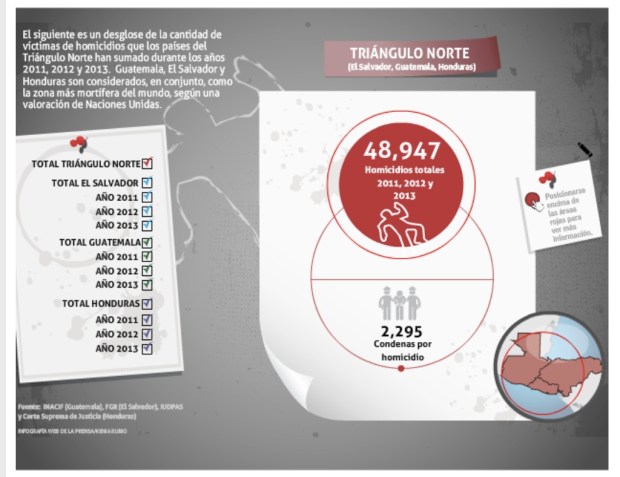
In the last three years, 48,947 people were killed in the Northern Triangle, the most violent region in the world, composed of Guatemala, Honduras and El Salvador. During these three years, the Northern Triangle countries brought a conviction in 2,295 of these cases, which leaves a homicide impunity rate of 95 percent. This is the reality of thousands of victims in the region: nations that do not guarantee justice or special programs of attention for the victims of this violence.

In El Salvador, 9,464 homicides have occurred between 2011 and 2013, with 490 convictions resulting, according to FGR. In 2011, 4,371 (630 women) were killed, and 124 were convicted. 3,047 were murdered with a gun. In 2012, 2,594 (322 women) were killed, and 103 were convicted. 1,592 were murdered with a gun. In 2013, 2,499 (216 women) were killed, and 263 were convicted. 1,676 were murdered with a gun. In Guatemala, 18,450 have been killed during from 2011 to 2013, and 1,268 were convicted, according to IMACIF. In 2011, 6,353 (732 women) were killed and 464 were convicted. 4,834 were murdered with a gun. In 2012, 6025 (708 women) were killed, and 447 were convicted. 4,625 were murdered with a gun. In 2013, 6,072 (758 women) were killed, and 357 were convicted. 4674 were killed with a gun. In Honduras between 2011 and 2013, 21,033 were killed, and 537 were convicted, according to IUDPAS and the Corte Suprema de Justicia (the Supreme Court of Justice). In 2011, 7,104 (512 women) were killed, and 101 were convicted. 6,009 were murdered with a gun. In 2012, 7,172 (606 women) were murdered, and 215 were convicted. 5,980 involved a gun. In 2013, 6,757 (636 women) were murdered, and 221 were convicted. 5,626 involved guns.

When they killed my girl, she was two years old, and I was 16. She was my first and only daughter. That day we were going to a vigil. We were walking down the street. When we passed by an area filled with mareros [gang members], a man came out who was kind of drunk. Behind him came another with a gun, and he started to shoot. The girl was walking next to us. When I turned to look behind, because it sounded like firecrackers, one was shooting at the other. We wanted to go, but a bullet had already hit my little girl. Her father picked her up in his arms. We didn’t even see how it hit her. She was still alive, but she died as we were walking. It would have been worse to see her suffer. These things happen.

The following are excerpts from an article that originally appeared in La Prensa Grafica and was translated and reprinted with permission. See the Spanish original here.

Later we heard they had arrested that guy, but who knows if it was the same one, because they got a bunch of them. Who knows if he is in prison. And is it going to come out in the paper that I am living here today? Very dangerous, better not even mention my name, or where we came from. Since October, I have been here. It is more peaceful here, not like in Mejicanos, although nowadays it’s nearly the same everywhere.

(The two-year-old girl was caught in the middle of crossfire in Mejicanos, in San Salvador. The mother of the girl, who is now 17, is awaiting her second child. She is five months pregnant.)

***

The Northern Triangle epithet was originally applied for commercial purposes, far from what it has now come to stand for: a synonym for violence. El Salvador, Guatemala and Honduras began to be known as the Northern Triangle after May 12, 1992, following the signing of a trade agreement in Nueva Ocotepeque, Honduras. However, the name became popular years later, in 2001, after the beginning of the Free Trade Agreement with Mexico.

Thirteen years have passed, and this commercial alliance has given way to another source of fame. During 2013, the Northern Triangle was again the most violent region in the world. Again. The United Nations had already given it this label a year earlier, when the homicide rate, which serves as an indicator of violence levels, rose above 50 deaths per 100,000 inhabitants.

In just 2013, there were 15,328 homicides in the Northern Triangle. When the perspective is widened to include the years 2011 through 2013, the figures paint a picture of a Central American cemetery: 48,947 tombs in those three years. Due to the multiplicity of homicides, the Northern Triangle has stopped naming its victims, and now just counts and accumulates them.

SEE ALSO: Coverage of Homicides

Each country, to a greater or lesser extent, has contributed to this quota. In Guatemala, for example, there were 18,450 homicides between 2011 and 2013. The Public Ministry’s (MP) secretary of criminal policy, Alejandro Rodriguez, provided an example of how Guatemalans have trivialized the homicides and the violence. According to Rodriguez, since 2009, when Guatemala had a murder rate of 46 per 100,000 residents, the Guatemalan newspaper Nuestro Diario (Our Daily) has been called by the nickname “Muerto Diario” (Daily Deaths).

“They changed the name to Muerto Diario because only photos of dead people appeared,” Rodriguez said on February 11, 2014 from his office in Guatemala City. He then paused, reddened, and laughed sharply.

***

In the following days, it bothered me to see other people happy. The people were not at fault, but I was bitter and deeply resentful. I was protesting to God. I said: “God, why? I put you in charge of them every night: ‘God, I entrust you with my sons, you see them, I do not.'” I spent about three months not wanting to know anything about God. I kept asking myself: why at that age, why like that? It hurt me so much to think about what my little boy might have felt, what pain. As a mother, one says, “Shit! My son has fallen!” and lifts him up, and even if it’s just saliva, you give it to them. And I wasn’t with him at that moment.

(Olinda Escobar, mother of Cristofer Lopez Escobar, murdered on January 22, 2011 in the El Calvario Bethesda church, located in the municipality of San Miguel Petapa, Guatemala. The 20-year-old Cristofer was murdered while participating in a wake for one of his best friends.)

***

In total, 9,464 people were murdered in El Salvador between 2011 and 2013, a time period that encompasses the gang truce initiated in March 2012, the pact that President Mauricio Funes has refused to recognize as his own strategy. The truce, while considerably decreasing the number of homicides in El Salvador, has not managed to halt the violence. What’s more, murders have again begun to rise, despite the agreement, since July 2013. This fact led Rigoberto Pleites, the director of the Salvadoran National Civil Police (PNC), to announce on March 3 this year that the “truce technically no longer exists.”

Over those same three years, the Salvadoran courts handed out 490 sentences for homicide cases, according to figures provided by the Attorney General’s Office — 490 sentences. This is equal to slightly over five percent of homicides committed in those same years. A quick calculation leaves little room for optimism: the impunity rate in El Salvador stands at over 94 percent.

***

That night he sent me a message. At about 8:20pm, he wrote saying I should tell mom and dad that he was going to come home late. That they shouldn’t worry, everything was okay. At around 9pm, I heard the shot. When we walked out, there was a terrible gathering. They were putting him in a car, but he didn’t fit. So they took him out and put him in a pick-up truck; even now we don’t know who it was that brought us. My parents stayed behind, because when my mother arrived on the scene she was so shocked she could not move. A cousin and I got in the truck to take him to the hospital. He practically had a bullet here and his eyes were closing… but he was alive because… well, we are Christians, and I was begging God so much to give us the strength to resist. So, he was alive because he had me by the hand, he was holding it so tight. And we arrived that way to the hospital.

(Claudia, the sister of a young man murdered in La Libertad on February 11, 2011, who asked not to be identified. She saved the last message her brother sent to her phone for two years — the same one that she mentions in this story. She finally lost it because her telephone broke.)

***

Next to the morgue in Honduras’ capital city of Tegucigalpa, there is a funeral home. It is a branch of the Los Olivos funeral home, which has been operating for 40 years. That office has been in place for 14 years. The smell of decay enters in waves into this room where the varnish of the coffins shines. According to Marta Ordoñez, one of the people in charge, the majority of the services are for homicides. “The violent deaths are mainly caused by drug traffickers,” she said. The work is never scarce here.

Etelinda Lopez, a pathology assistant with Honduras’ forensics institute, said that of every 10 bodies brought to the morgue, between seven and eight are for violent deaths. And while she admitted that the state had a duty to the victims’ families to provide them with a more dignified treatment (Honduras, like Guatemala and El Salvador, lacks a special victims unit), she said her work was affected by scarcities. Sometimes they do not even have gasoline for the vehicles to transport the cadavers. Forensic Medicine only has three offices where they perform autopsies in the entire country: Tegucigalpa, San Pedro Sula and La Ceiba.

“Not all of the [cadavers from] violent deaths are autopsied, because in some cases, we don’t have a way to transport the bodies. We are a regional office that is responsible for the entire central, south and eastern regions of the country. And within these regions, there are some particularly violent areas, like Olancho, where there is a great resistance to having bodies transported to Forensic Medicine,” said Lopez. For some cases, then, no autopsy occurs. If this does not happen, then there is no document establishing whether the death was due to homicide or not. And if this is not established, then the murder will certainly not be prosecuted. In Honduras, according to figures from the Supreme Court of Justice, for every 100 homicides, the perpetrators are sentenced in just three cases. That is to say: the impunity rate in the most violent country in the Northern Triangle is 97.44 percent.

In Honduras, 21,033 people have been murdered in the past three years, from 2011 through 2013. This represents an average of 19 people killed violently each day. A large number of these people are shot, according to statistics from the Violence Observatory of the University Institute of Democracy, Peace and Security (IUDPAS) at the National Autonomous University of Honduras. This, in practical terms, means a flood of images of people shot, dismembered and strangled on the Honduran television news channels, under titles such as “bloody spell.” There are many scenes in the Bajo Aguan region, in San Pedro Sula and in Tegucigalpa with victims for whom no responsibility is established in most cases. There are, even, distinguished reporters in the Forensic Medicine morgue. If there is ever a day when there have not yet been any murders, one is certain to occur shortly.

SEE ALSO: Honduras News and Profiles

“The problem is that when the state doesn’t investigate or prosecute, they open up the opportunity for people to arm themselves first, to take justice into their own hands. When we don’t demonstrate the reality and we are not transparent in telling it [how it is], this gives rise to people feeling that there is impunity. But later, they [feel that they] need to take justice into their own hands,” said Migdonia Ayestas, director of the Violence Observatory.

***

The person who killed my son already had been watching him, and shot him from behind. A neighbor, who lived about four houses down from mine, had sent him to buy cell phone minutes. When he returned, this person shot him from behind. The child wanted to defend himself because he had already been shot in the hand. If they had hit him from the front, maybe they would have injured him, but would not have killed him. But they shot him in the head. They shot him with so much hate… he had gunshots in his back and in his head. It is hard. Believe me, it is hard. I try to move forward, because I have my other son, but my life has been definitively changed. Before, I opened the store from Monday to Sunday and I only went to sleep in the house on weekends. My mom took care of them for me from Monday to Friday, but ever since that happened to my son, I realized it is not worth it and I no longer work Saturday or Sunday.

(Edith, who chose to use this name for the story, the mother of a 15-year-old youth murdered in Soyapango on December 19, 2010. Edith’s son was in ninth grade.)

***

“Chilling police corruption,” read the cover page of the Honduran newspaper El Heraldo on February 5, 2014. This special report referred to 202 police investigated for the crimes of corruption, hired killings and drug theft. It also mentioned that some police, instead of being removed from the force and prosecuted, had been retired “with honors” from the National Police. The stamp of drug trafficking is pervasive in the imagery of Honduran violence, just as the gangs are in El Salvador.

Honduras’ Attorney General Oscar Chinchilla had little problem admitting this. “We have to in some way strengthen the situation of our country in regard to the control and entry of drugs. Not all homicides are caused by drug trafficking, but a significant portion of the violence is generated by this problem,” said the official.

In a February 7 interview that took place in his Tegucigalpa office, Attorney General Chinchilla did not provide a percentage for the effectiveness of investigations, nor did he give the number of prosecutors assigned to the Life Unit, created in 2013 specifically for cases of violent deaths. He also failed to provide the case load number for each prosecutor. Honduras (this he did confirm) has 619 prosecutors spread throughout all of the country’s units. If all of these prosecutors were dedicated only to investigating homicides, in order to resolve the 21,033 cases between 2011 and 2013, each one would have to have a case load of 33.

***

When my husband stopped in the entryway, the life went out of me. I looked at him crying. Oh, God, I lost him then! My son, who didn’t buy anything if I didn’t approve. When my son lived here, my husband said: “The two sweethearts are chatting,” because he told me everything. He was a son… And he never left his church. And his brothers either… I still question it, and ask myself, “Why?” The thing is, here there is no justice. There is no justice.

(Yolanda Avila, 62-years-old, mother of Erick Alexander Martinez Avila, murdered on May 7, 2012 in Tegucigalpa, at the age of 33. The first time Yolanda saw her husband cry was when they killed his son. They had been married for 36 years.)

***

The Violence Observatory where Migdonia Ayestas works is part of the National Autonomous University of Honduras. The university president is Julieta Castellanos. Her son, Rafael, was murdered in Tegucigalpa in 2011.

Ayestas, the director of the Observatory at IUDPAS in Honduras, said that the Security Ministry has denied them, since July 2011, some homicide statistics to which only the police have access. The observatory uses the media’s bloody accounts to make up for the official underreporting, but there is a problem:

“If we don’t register a homicide, if a family member or my family member didn’t get registered, obviously [the murder] doesn’t exist. They are still alive. Or disappeared. But that person died. There is evidence that they were buried, that they have a name, a last name, a sex, a context in which it occurred,” said the IUDPAS director.

***

Yes, they shot me in the back too. It was December 7, 2011. We were going about our normal affairs as a couple. It was a good day, because I had been out of work. I was doing consultancy work at the time. With consultancy, sometimes there is work, and sometimes there isn’t. For him it was a good day, because it was the day for him to collect the modest, very modest, salary that he received as an adviser. And I had just gotten a new consultancy job. What I mean to say is, it was a day filled with happiness for us. And we were going down the street and they shot at us en route. They shot at him. I didn’t notice, because they shot me too. We crashed into a post. But my husband was already half dead. I crashed because I saw that he was mortally wounded. While I was looking at him, immediately, as if by magic, the police appeared. The police were watching over things. Or, I mean, everything was very well guarded. I think it was a crime that was totally… It wasn’t the police that killed him, but the police made sure the murder turned out well.

(Hilda Calderas, 56 years old, wife of Alfredo Landaverde, an expert in anti-drug matters and former security adviser, murdered on December 7, 2011 in Tegucigalpa, at the age of 71. Before beginning the interview, she paused in silence for a moment, while the pianist from the Honduras Maya Hotel played the song “Hello Dolly,” which he always used to play when they entered that hotel. This is where they were married on February 5, 1981, exactly 33 years before this interview.)

***

El Salvador has a National Victims’ Attention Office, which was created in 2011. This office, which is attached to the Security and Justice Ministry, has 20 employees and an annual budget of $172,000. Those 20 people attended 143 people last year, mainly victims of domestic violence, human trafficking or threats. Not one single family member of a homicide victim.

“This is the first time that the security framework has included the issue of responding to all of the trauma that El Salvador’s victims suffer, because this had always been left to the side. The office is starting with the stage of providing psychological, legal and social attention to the victims. It will need a lot more money to be able to help homicide victims,” said the Victims’ Attention director, Fatima Ortiz.

The unit calculated how much money it costs the country to provide attention to each victim. Attending a rape or sexual assault victim, for example, entails a cost of $5,000, which includes: legal and psychological counseling, supplies, accommodations and transport for six months. They have estimated that attention to victims of violence averages around $3,500. They would need at least $8.7 million to attend at least one family member (mother, son, wife, husband) of all 2,499 victims of homicide in 2013.

“One of our objectives is to ‘restore the social fabric,’ because we know that if not, the sickness will continue, but also when we began they gave us an incredibly broad mandate: homicides, all crimes. We know we will have to narrow it down. I think it will be part of the new government that ultimately makes that type of decision,” said Ortiz.

Response letter to USA Today article on Recent Salvadoran Elections

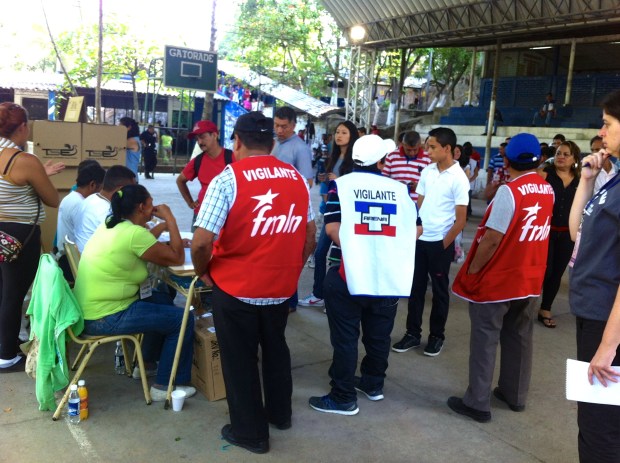
I submitted this response to the USA Today’s Editorial Board to clarify several inaccuracies in their recent article, “Stopping drug cartels key issue in El Salvador election” (http://www.usatoday.com/story/news/world/2014/03/08/el-salvador-election-central-american-cartels/6162315/). The editorial board did not respond to me, so I am posting it here. As background, I have been living in El Salvador since October 2013, observed eight polling stations during the run-off elections, and am conducting research that examines to what extent drug cartels and gangs work together, if at all.

RESPONSE

How to combat escalating violence partially caused by two transnational gangs – not drug cartels – was the key issue in El Salvador’s recent elections. Importantly, both gangs – MaraSalvatrucha 13 and Mara 18 – began in the United States, not in El Salvador, Guatemala or Honduras, where they now have the largest presence. In each of these nations, both gangs have contributed to increasing crime and homicide, especially since 2007.

 While increasing presence of drug cartels in El Salvador may be partially responsible for increasing gang crime, little evidence currently exists that El Salvador is a key transit site for drugs (although neighbors Guatemala and Honduras are known to be key transit points). Furthermore, Salvadorans do not believe drugs are a problem, and few Salvadorans use drugs (although the importance of the problem to Salvadorans and number of drug users have increased each year by small amounts).

 Possible root causes of escalating gang violence – like increasing drug cartel influence, poverty or inequality – were scarcely debated. The article indicates that the US has funded judicial training and youth crime prevention initiatives (which would presumably get at root causes), but few programs actually exist. Instead, the US continues investing millions (compared to billions in places like Afghanistan, Iraq and Israel) in strategies that have failed to curb drug supply abroad or demand at home. In fact, money has knowingly contributed to an increase in human rights abuses committed by US-trained-and-funded military and police forces and has failed to address poverty and inequality that lead poor farmers and youth to grow or distribute precursors to drugs and to join gangs.

 Problematically, political corruption has been entrenched in Central America since its banana republic days and is likely no worse today. Gangs have proven themselves capable of bribing officials for the past two decades, which does call into question El Salvador’s willingness to combat crime. For this and aforementioned reasons, Central American migrants detained at the Rio Grande sector have fled to seek protection, not to traffic drugs, as the article insinuated. Most have legitimate asylum claims, even though several articles have irresponsibly reported otherwise over the past few months.

 El Salvador is not Mexico, Guatemala or Honduras. It uniquely tried to engage gangs in creating solutions after acknowledging that zero tolerance approaches failed to impact crime levels. Because of the complexity of the nation’s problems though, and because of significant opacity around the government-negotiated gang truce, violence has now likely surpassed pre-truce levels. Still though, both FMLN and ARENA candidates wanted to continue using the military to combat gangs. Instead, both need to focus on improving rule of law and opportunities available to the young and impoverished.

 As a final note, the claims that President-Elect Sanchez Ceren has ties to international narcotraffickers and MS13 are unsubstantiated and were part of a smear campaign by the right-wing ARENA party.

CARTA DE RESPUESTA A USA TODAY SOBRE RECIENTES ELECCIONES SALVADOREÑAS

Presenté esta respuesta al consejo editorial de USA Today para aclarar varias imprecisiones en su reciente artículo  “Detención de cárteles de la droga, tema clave en las elecciones El Salvador”(http://www.usatoday.com/story/news/world/2014/03/08/el-salvador-election-central-american-cartels/6162315/). El consejo editorial no me respondió, así que lo público aquí. Como trasfondo, he estado viviendo en El Salvador desde octubre del 2013, observé ocho centros de votación durante las elecciones de desempate, y estoy llevando a cabo una investigación que examina en qué medida los cárteles de las drogas y las pandillas trabajan juntos.

RESPUESTA

Cómo combatir el aumento de la violencia, parcialmente, causada por dos pandillas transnacionales – no cárteles de drogas – fue el tema clave en las recientes elecciones de El Salvador. Cabe destacar que ambas pandillas – Mara Salvatrucha y Mara 18 – comenzaron en los Estados Unidos, no en El Salvador, Guatemala u Honduras, donde actualmente tienen una mayor presencia.   En cada una de estas naciones, ambas pandillas han contribuido al aumento de la delincuencia y homicidio, especialmente desde el año 2007.

 Si bien, el aumento de la presencia de los cárteles de droga en El Salvador puede ser, parcialmente, responsable del incremento de la delincuencia de las pandillas, actualmente, existe poca evidencia de que El Salvador es un sitio clave de tránsito de drogas (aunque los vecinos Guatemala y Honduras son conocidos por ser puntos de tránsito clave). Por otra parte, los salvadoreños no creen que las drogas son un problema, y ​​son pocos los salvadoreños que las consumen (aunque la importancia del problema para ellos y el número de usuarios de drogas ha ido en aumento, cada año, en pequeñas cantidades).

Profundas causas posibles sobre el aumento de violencia de las pandillas – como el incremento de la influencia de cárteles de droga, la pobreza o la desigualdad – apenas se debatieron. El artículo indica que los Estados Unidos ha financiado la formación judicial e iniciativas de prevención de delincuencia juvenil (lo que presumiblemente influye en las causas fundamentales), pero en realidad existen pocos programas. En cambio, los Estados Unidos continúa invirtiendo millones (en comparación con miles de millones en lugares como Afganistán, Irak e Israel) en estrategias que no han logrado frenar la oferta de drogas en el extranjero o la demanda en el país. De hecho, el dinero ha contribuido, como es sabido, a un aumento de las violaciones de los derechos humanos cometidas por las fuerzas militares y policiales entrenadas y financiadas de Estados Unidos y no ha podido abordar la pobreza y la desigualdad que conducen a los agricultores pobres y a los jóvenes  a distribuir drogas y a unirse a las pandillas.

Problemáticamente, la corrupción política ha sido atrincherada en Centroamérica desde sus días de “República bananera” y probablemente, hoy en día no es peor. Las pandillas han demostrado ser capaces de sobornar a funcionarios durante las dos últimas décadas, lo cual pone en cuestión la voluntad de El Salvador para combatir la delincuencia. Por esto y por razones antes mencionadas, los migrantes centroamericanos detenidos en el sector del Río Grande han huido en busca de protección, no para traficar drogas, como el artículo insinuaba. La mayoría tienen reclamos legítimos de asilo, a pesar de que varios artículos han informado, irresponsablemente, de otra manera en los últimos meses.

El Salvador no es México, Guatemala u Honduras. Este, únicamente, trató de involucrar a las pandillas en la creación de soluciones, después de reconocer que la cero tolerancia aproxima caídas que impactan en los niveles del crimen. Debido a la complejidad de los problemas de la nación y debido a la opacidad significativa en torno a la tregua entre pandillas negociada por el Gobierno, la violencia ha superado, probablemente, los niveles previos a la tregua. Aún así, tanto los candidatos del FMLN y de ARENA querían continuar utilizando a los militares para combatir a las pandillas. En cambio, ambos necesitan centrarse en la mejora del Estado de Derecho y las oportunidades disponibles para los jóvenes y los pobres.

Como nota final, las afirmaciones de que el Presidente electo, Sánchez Cerén, tiene vínculos con narcotraficantes internacionales y MS13 carecen de fundamento y eran parte de una campaña de desprestigio por el partido de derecha, ARENA.